中文版:说易(二)
I. The Eight Trigrams Form the Diagram
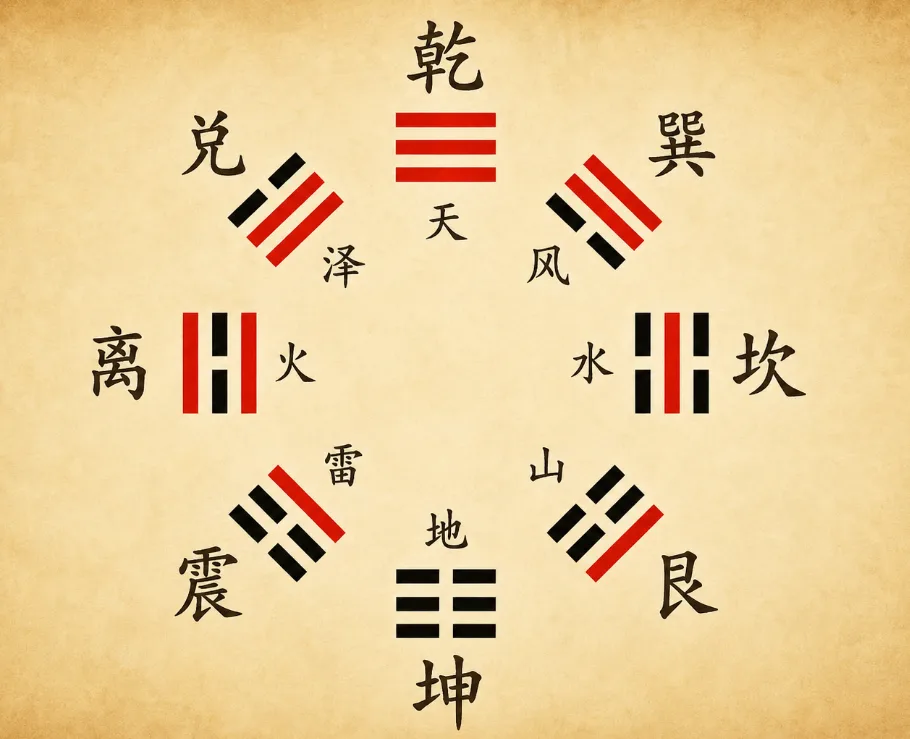
The previous article already covered the taiji, the two forces, the four symbols, and the eight trigrams. The next important development is the bagua diagram. The bagua diagram simply assigns the eight trigrams positions, placing each one in a different spot. And positioning is also the most important thing in life.
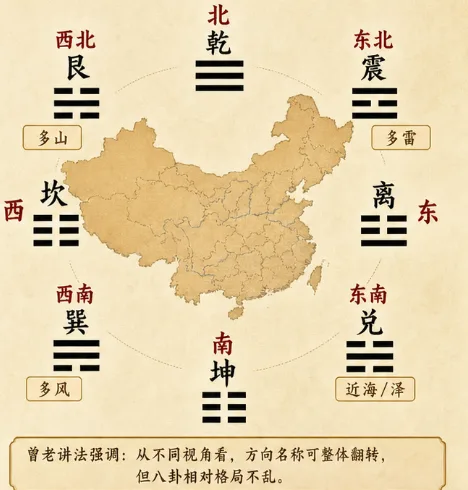
The most primitive eight trigrams, laid over a map with heaven to the north and earth to the south: the north is the qian trigram, which is heaven; behind it comes kun, which is earth. The most primitive bagua diagram also has some resemblance to the map of China. The southeast has a lot of sea, so it is the dui trigram; the east is where the sun rises, li; the west is the source of all rivers, kan; the southwest is windy, xun; the northwest is mountainous, gen; the northeast has plenty of thunder, zhen.
Nowadays the bagua is arranged with heaven to the south and earth to the north. But east, west, south, and north are relative and shifting; they are not absolute. There is a fixed structure, however: the relative positions of the four directions are set. Flip the whole thing top to bottom and swap the rest according to the relative relationships, and you’re done.
All branches of learning, from myth to philosophy to science, exist to solve the problems of the universe and of human life.
What philosophy takes seriously is the question, not the answer. Science takes the answer more seriously. Science contains some philosophical parts, and philosophy contains some mythological parts.
The eight trigrams were established with nature as the standard. Everything in the world takes nature as its standard.
There is no perfect circle in nature and no perfect straight line, which is why things are accomplished by curving (曲成). Anything that is accomplished cannot be a single straight line; only by winding along can you arrive. We often talk about the uncanny workmanship of nature, but everything nature forms naturally is not standard at all. It twists and turns, it is even bumpy and uneven.
Besides nature here on earth, astronomy also belongs to nature. Astronomy, strictly speaking, is the patterns in the sky. There is an old saying:
To observe the patterns of the heavens, so as to discern the shifts of the seasons; to observe the patterns of man, so as to transform and bring fulfillment to the world.
It is timing. It is fate.
When the times change, fate changes with them. No individual can hold back the trend of an age. Take the current AI era: nobody can ignore AI. Those who reject AI, or even those who compete with AI on the same axis, such as competing with AI on breadth of knowledge (this example may not be the best one; in the computer age it would be like competing with a computer on efficiency using a newspaper typewriter), will end up just like the people who rejected the internet: run over by the great wheel of the times.
Keep to the times, and await your mandate.
If the moment has not yet arrived, drag things out as long as you can. Building a Meituan-style delivery platform in 2000, for example, would not have fit the conditions of the time.
Confucius once said something that was later misunderstood by many people. I remember it was in my school textbooks back in the day too.
If a man hears the Way in the morning, he may die in the evening without regret.
This does not mean that once you understand it in the morning you can die in the afternoon.
The 朝 and 夕 here correspond to yin and yang; they are relative, not the literal meanings of morning and afternoon.
A better reading is this: the moment you understand a principle, let your past errors die as yesterday did, and then act in accordance with the principle.
II. The Most Important Thing in Life Is Positioning
The bagua diagram fixes the relative positions of the eight trigrams, and we need to fix a position for our own lives.
Of course, this position is relative as well. You could call it an ecological niche. Find the right niche and even an ant can live quite well.
Positioning:
- Knowing what you ought to do
- Knowing how to hold your position (守分, keeping to what is yours)
- Improving constantly
Getting the goal right, the direction right, and the bearings sorted out is far more important than speed.
When we play tug-of-war, we shout “one, two, three,” not “one, two, three, four.”
One: lock onto the target. Two: get your footing. Three: put your weight in.
The I Ching also speaks of the three powers (三才) and the three meanings.
The three powers are heaven, earth, and man. Above there is heaven, below there is earth, and the middle part is represented by man.
And this is why all eight trigrams are three-line trigrams: the three lines also carry the meaning of heaven, earth, and man.
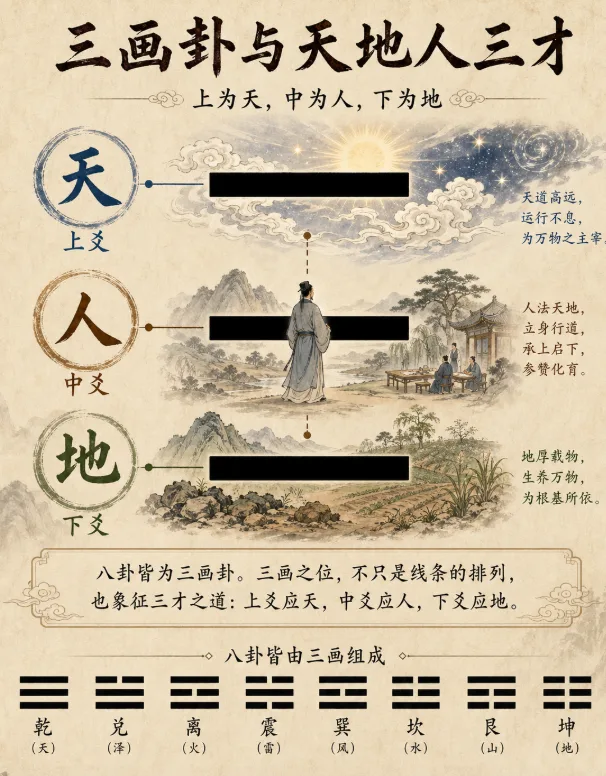
What is called the unity of heaven and man actually means the unity of the three powers, heaven, earth, and man. Heaven and earth each exercise its own nature: heaven moves vigorously, the lay of the land is yielding, and man stands with his head in the heavens and his feet on the earth.
There is a saying:
The right time, the right place, and harmony among men.
What heaven values is timing; what earth values is advantage; and man must have a team.
This brings to mind all the one-person companies these days. Getting things done entirely on your own is genuinely hard. Even if you can use AI to handle work in every domain, it still takes a heavy toll on your energy. Take Zhang Xuefeng, for instance: one person handling livestreaming, editing, and all sorts of things.
III. The 64 Hexagrams
The 64 hexagrams, simply put, come from turning three-line trigrams into six-line hexagrams: take the 8 trigrams, permute and combine them once more, stack them together, and you get the 64 hexagrams.
But the six-line hexagram did not come out of nowhere. A six-line hexagram is in fact already the complete hexagram.
So where does it come from?
In the original three-line trigram, the top, middle, and bottom are the three powers, heaven, earth, and man. And heaven, earth, and man each have both yin and yang within them. From that you get the six-line hexagram.
䷾